
Why Modular Data Centres Are Beating Greenfield Timelines – And When They Make Sense
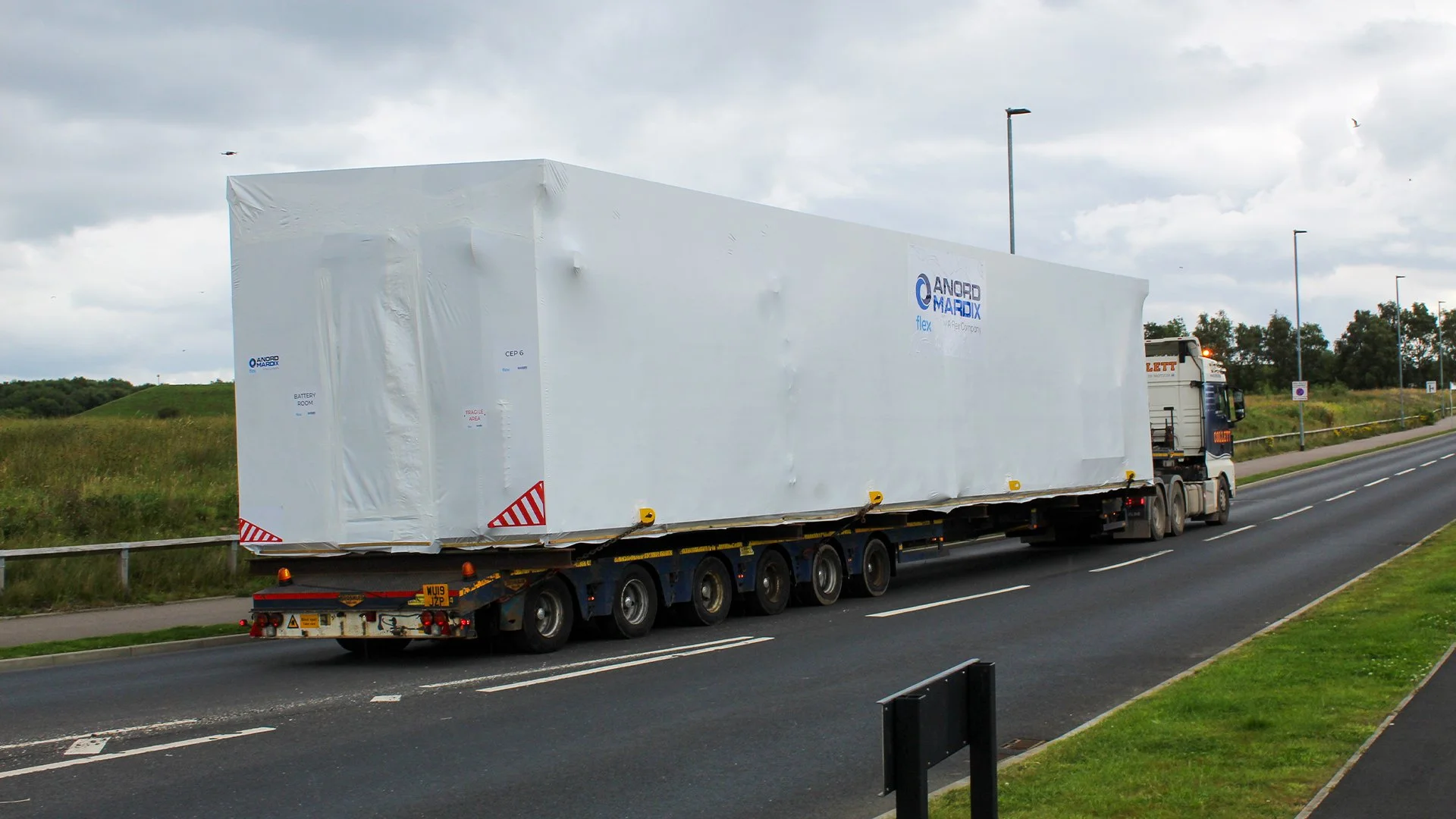
An Anord Mardix modular unit en route to a deployment site in the UK. Photo: Collett Transport.
The data centre industry has a timing problem. Traditional greenfield builds take 18-24 months from start to finish. AI workloads are doubling every six months. That gap isn't sustainable.
Enter modular deployments – prefabricated, factory-assembled units that are changing the math on speed, cost, and efficiency. These aren't compromised solutions. They're purpose-built infrastructure designed for the next decade of density and demand.
The Numbers That Matter
Modular data centres cut deployment time by 30% compared to traditional builds, with some units operational within 16-18 weeks. Construction costs run 30% lower than conventional builds, and that's before you factor in avoided over-provisioning.
Energy performance is equally compelling. Prefabricated facilities with chilled-water systems achieve PUE below 1.5, and some designs reduce energy consumption by up to 40% compared to traditional models.
The Water Story
Water efficiency deserves its own spotlight. A medium-sized data centre can consume 110 million gallons of water per year – equivalent to 1,000 households. Larger facilities? 5 million gallons per day.
Modular cooling systems are rewriting this equation. Designs built for water-constrained environments consume 80% less water than typical chiller systems. More advanced closed-loop liquid cooling eliminates evaporative water entirely – Microsoft's system saves more than 125 million litres per facility annually. In China, waterless X-Cooling systems are projected to save 1.2 million tons of water per 100 MW.
That's not incremental improvement. That's infrastructure that works in drought-prone regions.
Hyperscale Adoption
The hyperscalers aren't just testing this approach – they're standardising it. Meta uses prefabricated power and cooling modules across campus builds spanning 10+ buildings and 100+ megawatts. Their Prineville, Oregon facility deployed modular construction 50-75% faster than conventional timelines.
Google's modular designs with prefabricated cooling, electrical systems, and server racks have reduced construction timelines and achieved significant cost savings. AWS built a self-contained modular solution in shipping containers for tactical edge deployments, operational within weeks of site arrival.
Microsoft emphasises modular construction for rapid deployment and is actively developing immersion cooling and modular systems for next-generation facilities.
The market has taken notice. 93% of decision makers are making prefabricated modular data centres their default construction method, and 52% have already deployed them.
Where Modulars Make Sense
Modular deployments shine in specific scenarios: projects requiring less than 2-10 MW of incremental capacity, sites with constrained timelines, locations where power availability is a bottleneck, or builds in secondary markets where speed-to-revenue matters.
They're ideal when you need standardised, repeatable infrastructure – whether that's edge computing rollouts, expansion at existing facilities, or deployments where grid capacity won't support a full greenfield build for another 18 months. In those cases, modular power solutions can bridge the gap, allowing operators to install additional capacity now while permanent infrastructure catches up.
For projects requiring highly customised environments or deployments exceeding 50+ MW in a single phase, traditional builds may still be the answer. But for the growing share of capacity coming online to serve AI inference, 5G edge computing, and distributed cloud workloads, modular is increasingly the default.
What's Next
At PGP, we're watching modular infrastructure become central to how operators meet capacity demand without compromising on resilience or sustainability. In concert with our partners, we can support modular design delivery – whether it's 2 MW for edge deployments or 200 MW across a campus. Modular is increasingly the default for projects where speed and efficiency determine success.
The grid can't wait 24 months anymore. Neither should your build.